
Why Medicare Advantage HMOs and Direct Primary Care Don’t Mix

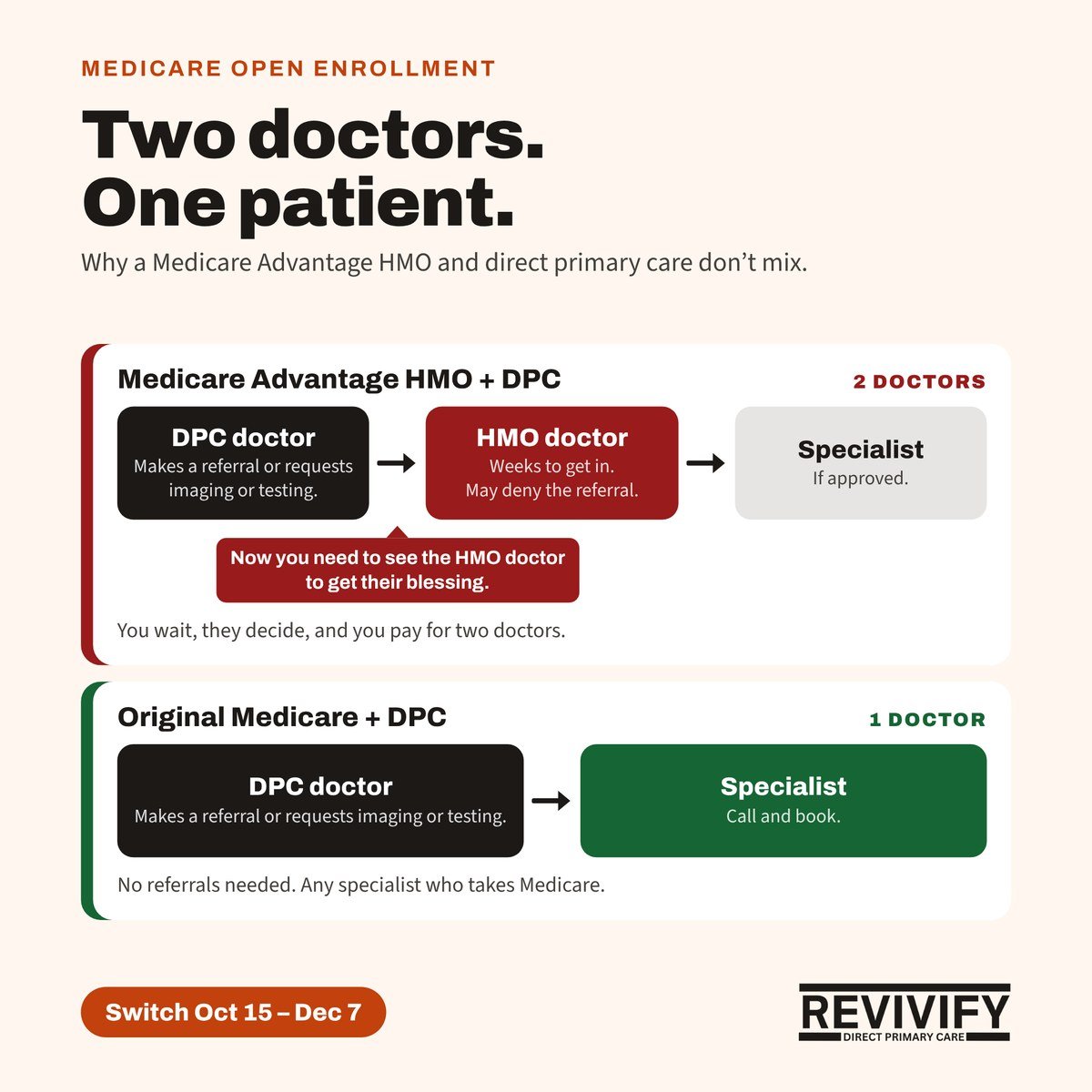
“I’ll just keep my HMO and add you on top.” I hear some version of this every week, usually from someone who’s sick of waiting three weeks for a ten-minute appointment. It sounds perfectly reasonable. Keep the cheap plan, add a doctor who actually has time. Best of both worlds, right?
In practice, it’s usually the worst of both. Here’s why a Medicare Advantage HMO and direct primary care tend to work against each other, what that looks like in real life, and what you can do about it when open enrollment opens on October 15.
The Problem: An HMO Already Has a Primary Care Doctor for You
HMO stands for Health Maintenance Organization. The whole model is built around one idea: a primary care doctor inside the plan’s network who coordinates, and controls, your care.
When you join an HMO, you pick (or get assigned) that doctor. They become your gatekeeper. Want to see a dermatologist, a cardiologist or a physical therapist? In most HMOs, that in-network doctor needs to send a referral first. And this is getting stricter, not looser. UnitedHealthcare, one of the largest Medicare Advantage insurers, moved to require most of its HMO and HMO-POS members to have a referral from their primary care doctor, submitted before the visit, for many specialist services starting in 2026.
A DPC doctor works outside every insurance network. I can’t be your HMO’s primary care doctor, because the HMO doesn’t pay me and I don’t contract with it.
The Insight: You’d Be Paying for Two Doctors and Only Seeing One
Picture how this plays out.
You join a DPC practice. You see me for your annual physical, your blood pressure, that nagging shoulder. I think you need to see a cardiologist. I send the referral. But your HMO says the referral has to come from your assigned primary care doctor. So now you call that office, wait for an appointment or a callback, and ask a doctor who’s never examined you to sign off on what I already recommended. That can take weeks, and they can say no.
Meanwhile, an HMO generally won’t pay for care you get outside its network, and some won’t cover tests or referrals ordered by an out-of-network doctor. So the labs I order may need to be re-ordered, or paid for in cash.
You’d be paying my membership, plus keeping a second doctor just to do paperwork. That’s not better primary care. That’s double the phone calls.
What the HMO Math Actually Looks Like
At Revivify, membership is $129 a month, or about $1,550 a year. For a patient on Original Medicare with a supplement, that buys a primary care relationship that fits neatly next to everything Medicare covers.
For a patient in an HMO, that same $1,550 buys the relationship, but not the authority to coordinate their care inside the plan. They still need their HMO doctor for referrals, and they may still face in-network rules on labs and imaging. The membership is worth less in that setup, and I’d rather tell you that up front than have you find out in March.
“But My HMO Has a Point-of-Service Option”
Some plans are HMO-POS, which let you go outside the network for certain services, usually at a higher cost. That can help with some specialists. But POS plans generally still require you to choose an in-network primary care doctor, and many still require referrals. A POS feature softens the HMO problem; it doesn’t solve it.
What About Integrated HMOs?
In California, many people are in integrated HMO systems where the insurer and the medical group are essentially one organization, like Kaiser Permanente. Those systems are designed for all your care to happen inside their walls. They can work well for people who like that model. They’re just not built to share your care with an outside primary care doctor.
Who This Is For
This post is for anyone in a Medicare Advantage HMO who’s frustrated with access to their primary care doctor and has been eyeing DPC as the fix. It’s also for adult children helping a parent sort out options this fall. If you’ve been told “just add a concierge doctor,” this is the fine print.
Myth-Bust: “It’s a $0 Premium, So the HMO Is Free”
The premium may be $0, but you still pay your Part B premium, plus copays and coinsurance up to the plan’s out-of-pocket limit. More importantly, you pay in time and access: networks, referrals and prior authorizations. For some people that tradeoff is worth it. If you want DPC, it usually isn’t.
What You Can Do
If you’re in an HMO and want direct primary care, you have real options:
- Get a Medigap quote first. Before you leave Medicare Advantage, find out whether you can get a Medicare Supplement policy and what it would cost. Depending on your health and your situation, it may not be guaranteed.
- Use open enrollment. From October 15 to December 7, you can switch from Medicare Advantage to Original Medicare and add a standalone Part D plan, effective January 1.
- Or use the do-over window. If you’re in Medicare Advantage on January 1, you can switch to Original Medicare once between January 1 and March 31.
- Consider a PPO if you prefer to stay in Medicare Advantage. It’s not a perfect fit with DPC, but it’s far more workable than an HMO.
- Get unbiased help. HICAP provides free Medicare counseling in California at 1-800-434-0222.
The Revivify Difference
I’d rather have fewer members whose coverage actually works with DPC than more members who are frustrated. That’s why I’ll always tell you honestly if your plan is going to fight our care model, and help you understand your options, even if the answer is “stay where you are for now.”
What’s Next
Next up: the other side of the story, what direct primary care adds when it’s paired with Original Medicare. If you’re in an HMO and want to know how a switch would affect your care, learn about our membership or call us at 858-429-0099.
This post is for general education and isn’t insurance advice. Revivify doesn’t sell insurance, and direct primary care is not insurance.
← Back to all posts