
Shockwave Therapy: The Evidence-Based Treatment for Injuries That Refuse to Heal

That nagging heel pain has been "almost better" for eight months. Your Achilles is perpetually cranky. Your shoulder does that thing every time you reach overhead. You've done the stretching, the ice, the rest — maybe even the cortisone shot — and yet here you are, still negotiating with your own body every time you try to move.
If that sounds familiar, you're not doing anything wrong. You may just have the wrong tool for the job.
Why Chronic Injuries Get Stuck
Chronic musculoskeletal pain is notoriously hard to treat because most conventional approaches address the symptom — the pain — without addressing the underlying tissue failure. Cortisone injections reduce inflammation in the short term but can actually weaken tendons over time and do nothing to promote actual healing. Physical therapy helps, but only if the tissue is capable of responding to load. And surgery is a significant commitment — downtime, anesthesia, recovery, and no guarantee of a better outcome than conservative care.
What most chronic tendon and soft tissue injuries have in common is that they've moved past the acute inflammatory phase into a state of degenerative change. The tissue isn't actively healing anymore — it's stuck. Telling a stuck tendon to rest and ice itself back to health is like telling a car with a flat tire to sit in the garage and think about it. What chronic injuries often need isn't less stimulus — it's the right kind of stimulus. Specifically, a mechanical signal that tells the body to restart the healing process, recruit new blood supply, and regenerate damaged tissue. That's exactly what shockwave therapy delivers.
What Is Shockwave Therapy, and How Does It Work?
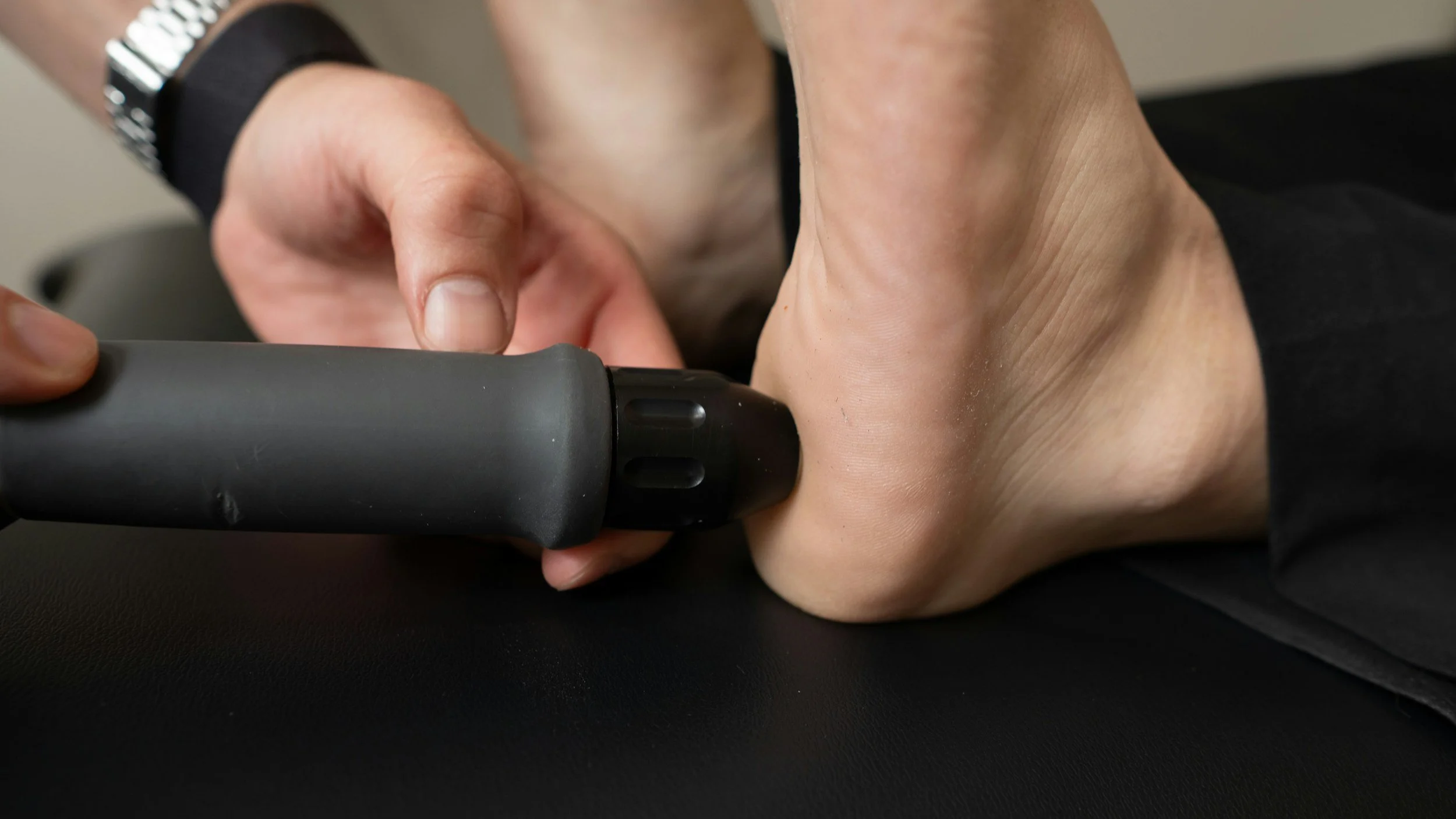
Shockwave therapy — technically called extracorporeal shockwave therapy, or ESWT — delivers high-energy acoustic pressure waves to injured tissue from outside the body (that "extracorporeal" prefix means "outside the body"). A handheld device is placed over the treatment area and emits rapid pulses of energy that penetrate deep into tendons, fascia, muscle, and bone.
These acoustic waves do several things at once. They mechanically break down calcified deposits that form in chronically damaged tissue, stimulate the production of new collagen — the structural protein that gives tendons their strength — and trigger the release of growth factors that signal the body to send in fresh blood supply and repair cells. In other words, shockwave therapy reactivates a healing process that has stalled out.
There are two main types: focused shockwave, which concentrates energy at a specific depth for precision treatment, and radial shockwave, which disperses energy over a broader area for surface-level and muscular conditions. Both have strong clinical support, and at Revivify we select the right type — or combination — based on your specific injury and treatment goals.
What Conditions Does Shockwave Therapy Treat?
The short answer: a lot. The longer answer is that shockwave therapy has some of the strongest evidence in regenerative medicine for the following conditions:
Plantar fasciitis — the most-studied application of ESWT, with multiple randomized controlled trials showing significant pain reduction and improved function, including in patients who failed all other conservative treatments
Achilles tendinopathy — both insertional and mid-substance, where shockwave outperforms eccentric exercise alone in multiple studies
Calcific shoulder tendinitis — shockwave physically fragments calcium deposits and triggers reabsorption, often producing dramatic, fast improvement
Patellar tendinopathy (jumper's knee) — widely used in elite sports medicine for this notoriously stubborn condition
Tennis and golfer's elbow — lateral and medial epicondylitis respond well, particularly in chronic cases where cortisone has already been tried
Rotator cuff pathology — including partial tears and chronic tendinopathy
Hip pain — including greater trochanteric pain syndrome and gluteal tendinopathy
Stress fractures — ESWT is used to stimulate bone healing in stress reactions and slow-to-heal fractures
Chronic muscle pain and trigger points — radial shockwave is highly effective for releasing deep, stubborn muscular tension
If there's a tendon or piece of connective tissue involved, there's very likely a shockwave protocol for it.
The Evidence: This Isn't New, and It Isn't Fringe
Shockwave therapy has been used clinically in Europe since the early 1990s — initially developed in Germany and Switzerland, where it has been a mainstream orthopedic and sports medicine tool for over three decades. Much of the early research was published in European medical journals, which is part of why American medicine was slower to adopt it. The science, however, has been robust for a long time.
Today, ESWT is endorsed by major international sports medicine and orthopedic organizations. There are hundreds of peer-reviewed studies, multiple systematic reviews, and meta-analyses supporting its use for the conditions listed above. The Journal of Orthopaedic Surgery and Research, the American Journal of Sports Medicine, and numerous European clinical journals have all published high-quality evidence validating this approach. This is not an experimental treatment — it's a proven, mature technology that the rest of the world figured out while we were still defaulting to cortisone and "just take it easy."
The research is also continuing to expand. Recent studies have explored ESWT's role in bone regeneration, wound healing, and even cardiovascular tissue repair. The mechanism is well understood, the outcomes are well documented, and the clinical track record spans three continents.
What the Treatment Actually Feels Like — and What to Expect
Each session typically takes approx 15 minutes. The device is pressed against the skin over the treatment area, usually with a small amount of ultrasound gel to help transmit the waves. You'll feel a rapid tapping or pulsing sensation — some patients describe it as intense but very tolerable, others find it mildly uncomfortable over particularly sensitive areas. There's no anesthesia required, no needles, and no incisions.
Most patients need 3–6 sessions, spaced approximately one week apart, to achieve meaningful results. Some notice improvement after the first or second treatment; others see the biggest gains in the weeks following the final session, as the biological healing response continues to unfold. The body's repair process takes time — shockwave starts it, but the full benefit accumulates over weeks.
Here's one of the most important distinctions between shockwave therapy and many other treatment approaches: it doesn't require you to shut your body down to get results. There's no surgical recovery, no hormonal suppression, no systemic medications with side effects, and no mandatory weeks of complete rest. Most patients can continue training and normal activity between sessions — with appropriate guidance — and the treatment works with the body's own biology rather than overriding it. For active people, that's not a small thing.
Cost-Effective and Easy to Combine With Other Therapies
Compared to surgery, shockwave therapy is dramatically less expensive — and far less risky. There's no operating room, no anesthesia fees, no weeks away from work, and no surgical complications to manage. For most chronic tendon conditions, it represents an evidence-based, cost-effective path to real recovery that many patients never hear about before being handed a surgical referral.
It's also highly complementary to other regenerative therapies. At Revivify, we frequently combine shockwave therapy with PRP (platelet-rich plasma) injections for an even more powerful healing response — the shockwave primes the tissue and increases local blood flow, while the PRP delivers a concentrated dose of growth factors directly into the injury zone. Physical therapy, nutritional support, and optimized hormonal health can all work synergistically with ESWT to accelerate and sustain results. If your situation is complex, you don't have to choose one tool — you can use several.
Who Is a Good Candidate?
Shockwave therapy is especially well-suited for people who have been dealing with a soft tissue or tendon injury for more than 3–6 months, have tried stretching, physical therapy, and/or cortisone injections without lasting relief, and want to avoid surgery or aren't yet at the surgical threshold. It's also an excellent option for athletes who need to stay active during treatment and can't afford a prolonged recovery window.
Shockwave is not appropriate in every situation — it's contraindicated in pregnancy, over active infections, and in certain bleeding disorders — which is why a proper evaluation before treatment matters. But for the right patient, it's one of the safest and most effective tools in regenerative medicine. If you've been told your only options are "more rest" or "let's talk surgery," it may be worth asking whether you've actually exhausted your options — or just the ones your current provider knows about.
The Revivify Difference
At Revivify Restorative Medicine, shockwave therapy isn't a standalone procedure we hand you a pamphlet about. It's part of a broader philosophy of treating the whole person — combining regenerative tools like ESWT and PRP with hormonal optimization, nutrition, and genuinely personalized care. Our Direct Primary Care model means you're not a 12-minute appointment on a conveyor belt. You're someone we actually know, and we'll take the time to understand your injury history, your goals, and what you've already tried — before recommending a path forward. If shockwave therapy is right for you, we'll tell you. If it isn't, we'll tell you that too.
Ready to Stop Negotiating With That Injury?
If a stubborn tendon issue, chronic pain, or a nagging injury has been limiting you for longer than it should, shockwave therapy may be exactly what you've been missing. Check us out for more info at revivifymed.com, or call for an appointment at 858-429-0099 and let's figure out what's actually going on — and what we can actually do about it.