
Regenerative Medicine for Athletes:Heal Smarter, Not Harder
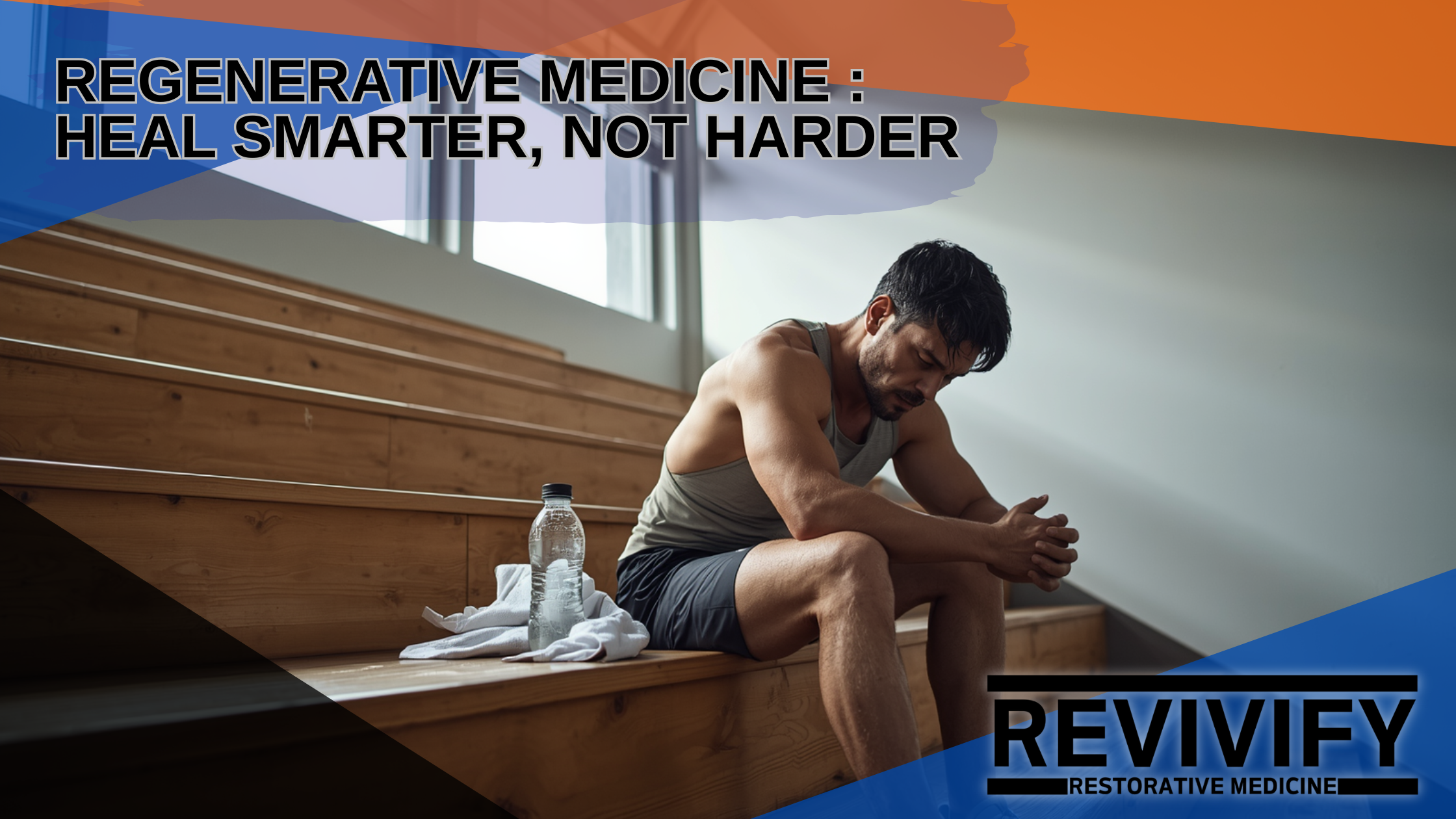
You finally carved out Saturday for a long run — felt great the whole time. By Sunday morning, your knee is talking back at you in a language that's hard to ignore. Or maybe you've spent twenty years on a warehouse floor, lifting, twisting, and grinding through shifts, and your body is starting to hand you the invoice. Either way, you've done the rest, the ice, the ibuprofen routine — and it keeps coming back. There's a reason for that, and there's a better path forward.
Why "Rest and Repeat" Isn't Always Enough
Chronic pain and slow-healing injuries share a common culprit: your body's natural repair process gets stuck or overwhelmed. Tendons, ligaments, and cartilage have notoriously poor blood supply, which means they heal slowly on their own — and sometimes incompletely. Anti-inflammatories can quiet the fire, but they don't rebuild the tissue. Surgery can fix structural problems but comes with recovery time, rehab costs, and real risks. Physical therapy is invaluable, but when there's underlying tissue damage or structural instability, strengthening exercises alone can only do so much.
This is the gap that leaves athletes, weekend warriors, and industrial workers cycling through flare-ups for months or even years. The injury technically "healed" — but the tissue is weaker, the mechanics are off, and the pain keeps showing up like an uninvited guest every time you push.
What Is Regenerative Medicine — and Why Does It Work Differently?
Regenerative medicine is an approach that uses your body's own biological materials — or targeted physical therapies — to stimulate true tissue repair, not just symptom relief. Instead of suppressing the body's response or working around the problem, regenerative treatments jump-start the healing process at the cellular level.
The idea isn't new — the foundational science has been building for decades — but the tools available today are far more refined, precise, and accessible than they used to be. For people who are active by choice (athletes and weekend warriors) or by occupation (nurses, construction workers, warehouse staff — the "industrial athletes" who rarely get credit for how physically demanding their jobs are), regenerative medicine offers something the standard playbook doesn't: the realistic possibility of getting structurally better, not just managing through.
The Regenerative Treatments We Offer at Revivify
At Revivify, we've built our approach around a toolkit of proven regenerative therapies that can be used alone or in combination depending on what your body actually needs. No one-size-fits-all protocols here.
Platelet-Rich Plasma (PRP) Therapy
PRP is one of the most well-researched regenerative treatments available. We draw your blood, spin it in a centrifuge to concentrate the platelets — the components packed with growth factors — and inject that concentrated solution directly into the damaged area. Platelets are your body's first responders for tissue repair, and delivering a high concentration of them to a stubborn injury site can meaningfully accelerate healing and reduce chronic inflammation. PRP is used widely for tendon injuries, ligament sprains, osteoarthritis, and soft tissue problems that haven't responded to conventional care.
Bone Marrow and Adipose (Fat) Injections
For more significant tissue damage or moderate to more advanced joint degeneration, we can harvest your body's own stem-cell-rich material — either from bone marrow or from adipose (fat) tissue — and inject it into the affected area. These therapies deliver a concentrated supply of mesenchymal stem cells and other regenerative compounds that can support cartilage repair, reduce inflammation, and encourage the kind of structural healing that other treatments simply can't replicate. If PRP is a spark, think of bone marrow and adipose treatments as the full repair crew.
Hydrodissection
If you've got nerve pain, tingling, radiating symptoms, or stubborn soft tissue restrictions, hydrodissection may be the piece of the puzzle you haven't tried yet. The technique uses a precisely guided fluid injection to physically separate compressed or entrapped nerves and fascia from the surrounding tissue. It sounds simple, but it can produce dramatic results — particularly for people with carpal tunnel syndrome, piriformis syndrome, thoracic outlet syndrome, or other conditions where a nerve is getting squeezed somewhere along its path. Think of it as releasing a kinked garden hose rather than just turning down the water pressure.
Perineural Injection Therapy (PIT)
Perineural injection therapy targets a different layer of the problem: the small, superficial nerves that become sensitized and inflamed in areas of chronic pain. These nerves fire repeatedly, feeding a pain cycle that can persist long after the original injury has technically healed. PIT uses a series of small subcutaneous injections of a dextrose solution to calm these overactive nerve endings and break that cycle. Patients often notice a reduction in overall pain sensitivity, improved range of motion, and better response to other treatments. It pairs especially well with other regenerative procedures.
Shockwave Therapy
Extracorporeal shockwave therapy (ESWT) delivers targeted acoustic energy pulses into damaged tissue using a handheld device — no needles, no downtime. The shockwaves create controlled microtrauma that triggers the body's natural repair response: increased blood flow, growth factor release, and accelerated tissue remodeling. Shockwave is particularly effective for chronic tendinopathies (plantar fasciitis, Achilles tendinitis, patellar tendinopathy, tennis elbow) where tissue has become calcified or degenerative over time. It's one of the only non-invasive options that can actually turn degenerative tissue back toward healthy tissue — not just manage the symptoms.
Prolotherapy
Prolotherapy is one of the oldest regenerative techniques, and it's still highly effective — particularly for joint instability, ligament laxity, and areas where the structural foundation needs reinforcing. We inject a dextrose (sugar water) solution into ligaments, tendons, and joint spaces, which creates a mild, controlled inflammatory response that triggers the body's natural repair cascade. Over a series of treatments, the tissue becomes denser, stronger, and more stable. If hypermobility, recurring sprains, or chronic low-grade joint pain is your issue, prolotherapy deserves a serious look.
Who Is This For?
Regenerative medicine is a strong fit if you're someone who is genuinely active — whether that means training for a race, hiking on weekends, coaching your kid's soccer team, or logging ten-hour shifts on your feet — and you've got a nagging injury or chronic pain that hasn't responded to standard care. If you've been told to "just manage it," or if you've tried cortisone shots that give you a few weeks of relief before the pain returns, or if surgery feels like too big a hammer for what might be a nail problem, you're in the right place. These therapies are also worth exploring if you want to stay ahead of degeneration and keep performing at a high level well into your 50s, 60s, and beyond.
Common Questions (And Honest Answers)
"Is this experimental?" Not anymore. PRP, shockwave, and prolotherapy have decades of clinical use behind them. Bone marrow and adipose therapies have a robust and growing body of research. None of these are fringe treatments — they're used by professional sports teams, orthopedic specialists, and academic medical centers worldwide. That said, regenerative medicine is not magic, and no provider who's being straight with you will guarantee outcomes. What these treatments offer is a genuine opportunity for biological repair — which is something most conventional options can't claim.
"How many treatments will I need?" It depends on the therapy and the condition. Shockwave often produces results in three to five sessions. PRP may be a single injection or a short series. Prolotherapy typically involves multiple rounds spaced several weeks apart. Your provider will walk you through realistic expectations before you commit to anything.
The Revivify Difference
At Revivify, we don't run you through a factory. Our Direct Care model means your provider has the time to actually understand your history, your activity level, your goals, and what you've already tried. We combine regenerative therapies with a root-cause approach — because the best injection in the world won't hold if the underlying biomechanics, movement patterns, or lifestyle factors are working against it. We want you moving well and staying that way, not coming back every six months for another band-aid.
Ready to find out which regenerative approach makes sense for your injury, your goals, and your body? Have a look at revivifymed.com — or reach out directly and we'll point you in the right direction. And if you're not quite ready to book but you want to keep learning, follow us for straightforward, no-hype content on regenerative medicine, performance, and longevity.
Facebook: https://www.facebook.com/RevivifyMed/
Instagram: https://www.instagram.com/revivifymed/
YouTube: https://www.youtube.com/@RevivifyMed