
Shockwave Therapy: The Evidence-Based Treatment for Injuries That Refuse to Heal
That nagging heel pain that's been “almost better” for eight months. The Achilles that's perpetually cranky. If you've tried rest, physical therapy, and cortisone — and you're still stuck — you're not alone, and you're not out of options.
Why Chronic Injuries Get Stuck
Chronic musculoskeletal pain resists treatment because conventional approaches target symptoms rather than the underlying tissue damage. Cortisone injections offer short-term relief but can weaken tendons over time. Physical therapy helps — but only if the tissue is capable of responding to load. Surgery carries real risk without a guarantee of a better outcome. Left long enough, these injuries progress into a degenerative state where the tissue simply stops actively healing. The fix isn't more rest — it's the right kind of stimulus to signal your body to restart the healing process.
What Is Shockwave Therapy, and How Does It Work?
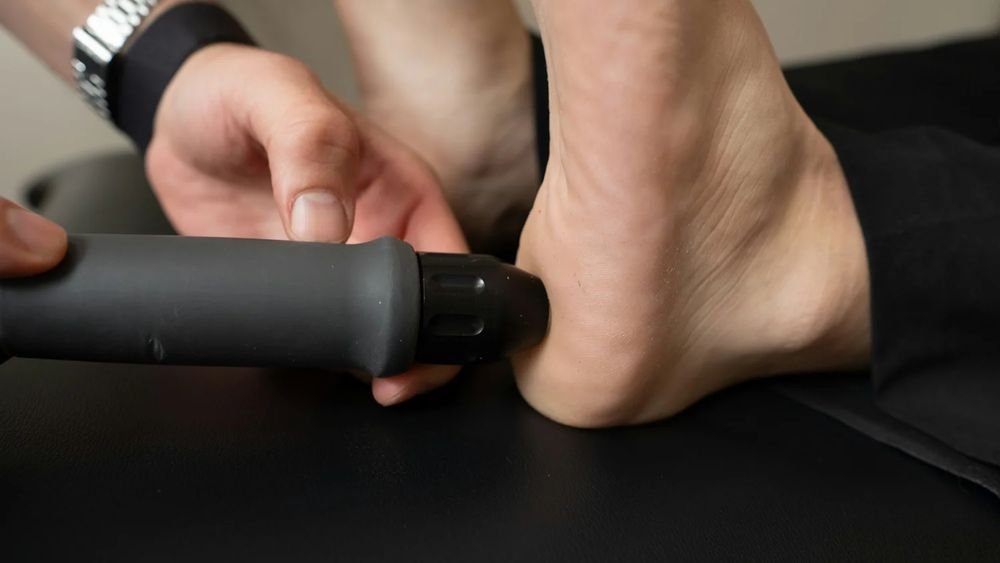
Extracorporeal shockwave therapy (ESWT) delivers high-energy acoustic pressure waves to injured tissue from outside the body, through a handheld device. Those waves mechanically break down calcified deposits, stimulate new collagen production, and trigger the release of growth factors that bring blood supply and repair cells to the injury site. We use two types depending on the injury and treatment goals: focused shockwave, which targets a precise depth, and radial shockwave, which distributes energy across a broader surface.
What Conditions Does Shockwave Therapy Treat?
The strongest evidence exists for:
- Plantar fasciitis (the most-studied application)
- Achilles tendinopathy
- Calcific shoulder tendinitis
- Patellar tendinopathy (jumper's knee)
- Tennis and golfer's elbow
- Rotator cuff pathology
- Chronic hip pain
- Stress fractures
- Chronic muscle pain and trigger points
This Isn't New, and It Isn't Fringe
Shockwave therapy has been used clinically in Europe since the early 1990s, originating in Germany and Switzerland as a mainstream orthopedic tool — American medicine was simply slower to adopt it, in part because the early research was published primarily in European journals. Today it's endorsed by major international sports medicine and orthopedic organizations, and backed by hundreds of peer-reviewed studies and multiple systematic reviews and meta-analyses in journals like the Journal of Orthopaedic Surgery and Research and the American Journal of Sports Medicine.
What to Expect
A session takes about 15 minutes. You'll feel a rapid tapping or pulsing sensation — intense, but tolerable. No anesthesia, no needles, no incisions. Most people need 3 to 6 sessions spaced about a week apart. Some feel improvement after the first couple of treatments; others notice their biggest gains in the weeks after the final session, as the biological healing process continues to work. And unlike a lot of other approaches, shockwave doesn't require you to shut everything down — with the right guidance, you can keep training and stay active between sessions.
Cost-Effective, and Easy to Combine With Other Therapies
Shockwave costs a fraction of surgery, with no operating room, no anesthesia, and no prolonged recovery. We frequently combine it with PRP (platelet-rich plasma) injections for an even stronger healing response, and pair it with physical therapy, nutritional support, and hormonal optimization to accelerate results further.
Who Is a Good Candidate?
If you've had a soft tissue or tendon injury for 3 to 6 months, tried stretching, physical therapy, and/or cortisone without lasting relief, and want to avoid surgery, shockwave therapy is worth a conversation — especially if you're an athlete who needs to stay active during treatment. It's not right for everyone: pregnancy, active infections, and certain bleeding disorders are contraindications, which is why a proper evaluation comes first.
The Revivify Difference
We don't treat shockwave therapy as a stand-alone gadget — it's one part of a comprehensive, whole-person treatment plan that combines ESWT and PRP with hormonal optimization and nutrition. Our Direct Primary Care model gives us the time to actually understand your injury history and what you've already tried before we recommend anything.
If you've got a tendon issue or chronic pain that just won't quit, give us a call — we'd love to talk through whether shockwave therapy is right for you.
← Back to all posts