
Knee Arthritis Treatment Without Surgery, Stage by Stage

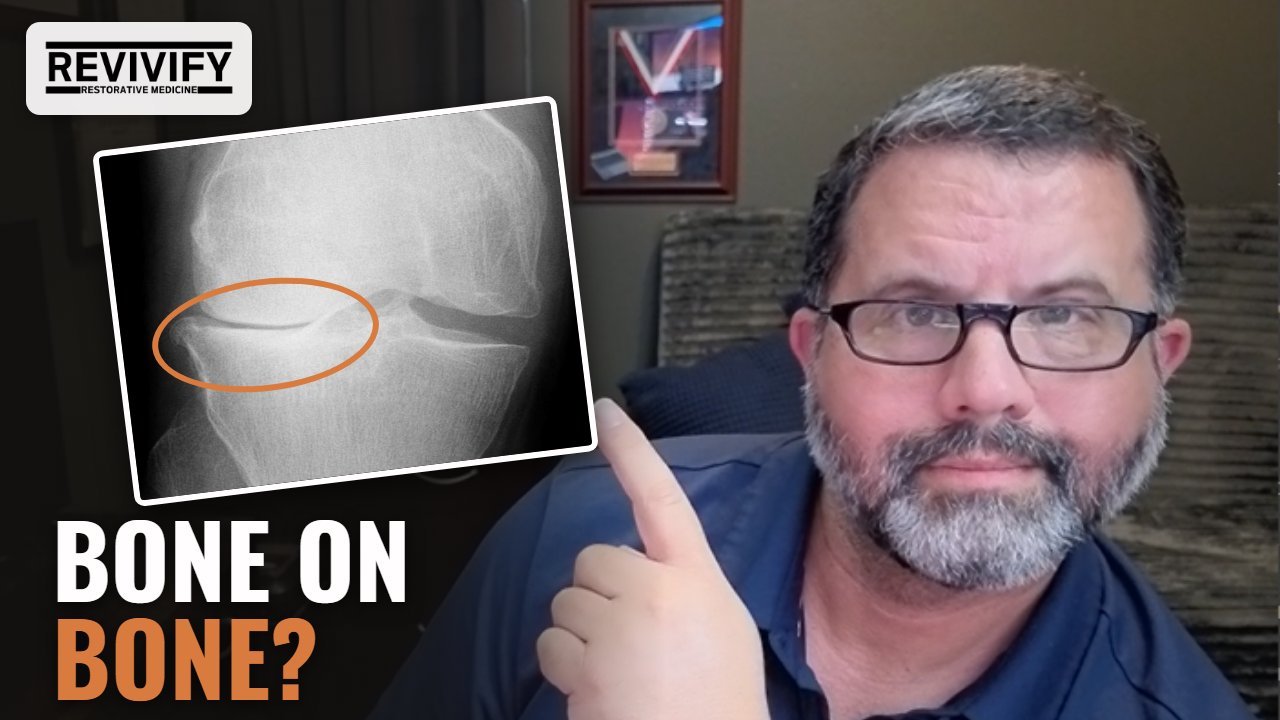
X-ray: J. Lengerke, CC BY-SA 3.0 DE, via Wikimedia Commons
Bone on bone. If you’ve heard those words about your knee, you’ve probably also heard a long list of options: gel shots, PRP, stem cells, supplements, braces, surgery. Some of them work, some barely beat a placebo, and some cost thousands of dollars for evidence that isn’t there yet. So let’s go through knee arthritis treatment without surgery the way I’d walk you through it in my office: the four stages, and what the research actually supports at each one.
I’m Dr. Stephen Daquino, a board-certified sports medicine and family medicine physician here at Revivify Restorative Medicine in San Diego. I treat knee arthritis every week and I do a lot of these injections myself, so I’m going to be straight with you, including about the treatments I offer.
If you’d rather watch than read, the whole thing is in this video, with every study on screen.
What knee arthritis actually is
The ends of the bones in your knee are lined with smooth cartilage, which lets one surface glide across the other without much friction. It’s almost Thanksgiving, so think about a turkey leg: the end of the bone has that shiny surface on it. That’s articular cartilage. Osteoarthritis is when that cartilage slowly wears thin, and then the bone, the joint lining and the tissue around it all react.
Here’s what most people don’t know. Your X-ray and your pain don’t always match. Plenty of people with ugly X-rays feel fine, and plenty of people with mild X-rays hurt a lot. So the stage helps guide the treatment, but we always treat you, not your X-ray.
The four stages of knee arthritis
Doctors usually grade knee arthritis on an X-ray from one to four, using what’s called the Kellgren-Lawrence scale.
- Stage 1, doubtful: maybe a tiny bone spur, and the joint space looks pretty normal.
- Stage 2, mild: definite bone spurs, and the space may be starting to narrow.
- Stage 3, moderate: clear narrowing of the joint space, several spurs, and some hardening of the bone, which we call sclerosis.
- Stage 4, severe: this is what people call bone on bone. Big spurs, very little space left, and the ends of the bones start changing shape.
What helps at every stage
Exercise, specifically strengthening. This is the biggest bang for your buck at every stage. Strong thighs and hips take load off the joint, and both major guidelines (the American Academy of Orthopaedic Surgeons and the American College of Rheumatology) give exercise their top ratings. Start simple: sit to stand from a chair, straight leg raises, side steps with a band. Add biking, swimming or walking. Some soreness is okay as long as it settles by the next morning. My last video goes through the best exercises for knee pain.
Physical therapy is definitely worth it. In one trial, people who did physical therapy had less pain and better function at one year than people who got cortisone shots. If you’re not ready to exercise hard and want to ease into things, try tai chi. The rheumatology guideline strongly recommends it.
Weight, if you carry extra. Every pound you lose takes about four pounds of force off your knee with each step. In one large trial, people who lost about 10% of their body weight with guided exercise cut their knee pain roughly in half.
Weight loss medications are part of this now too, and it’s a big deal. In a 2024 trial, people with obesity and knee arthritis who took semaglutide lost about 14% of their body weight and had much less knee pain than people on placebo. Those medications aren’t right for everyone, so that’s a conversation to have with your doctor.
Stages 1 and 2: early knee arthritis
In the early stages, exercise and weight management are the main event. Everything else is support.
Topical anti-inflammatories like diclofenac gel work well for knees. Very little gets into your bloodstream, so they’re easier on your stomach and kidneys than pills. If you do use oral anti-inflammatories like ibuprofen, limit how much you take, because they can be harsh on your stomach and kidneys. Just because two pills feel good doesn’t make three or four better. Stay within the dose on the bottle, and if you need something stronger, talk to your own physician and stick to their prescription.
Ice or heat are both fine for short-term relief. Heat usually feels better for stiffness, and ice for a flare after activity. The rheumatology guideline gives them a conditional yes. They’re cheap and safe, but they’re comfort more than a fix. Same with a compression sleeve: some people feel more supported in one, but there’s very little research on sleeves.
Acetaminophen (Tylenol) is an option too. The benefit is small, and you have to watch your total daily dose because of your liver. The maximum is 4,000 milligrams in 24 hours, but I generally tell my patients to take no more than 3,000 milligrams a day. Think two 500 milligram extra strength Tylenol three times a day, and we don’t go over that.
Supplements for knee arthritis: what the studies show
This is where a lot of the money goes.
- Glucosamine and chondroitin: the biggest US trial found no meaningful benefit over placebo for most people. The orthopedic guideline says they may help but the evidence is inconsistent, and the rheumatology guideline recommends against them. They’re generally safe, so if you try one, give it about three months and stop if you don’t notice a difference.
- Turmeric (or its active ingredient, curcumin) has better data than most supplements. A 2020 trial found a turmeric extract eased knee pain more than placebo over 12 weeks. The dose was 1,000 milligrams a day of the manufacturer’s own extract, so a random capsule from the store may not match what was tested. It isn’t risk free: there are reported cases of liver injury, often with products that add black pepper extract to boost absorption, and it can add to the effect of blood thinners. If you take a blood thinner like warfarin, ask your doctor first.
- MSM (methylsulfonylmethane): one small trial found a modest improvement in pain and function over about 12 weeks. Small study, small effect.
- Undenatured type II collagen beat placebo in a trial funded by its manufacturer. Promising, but it needs independent confirmation.
- Fish oil and vitamin D: the rheumatology guideline recommends against both for knee arthritis.
Bottom line, turmeric has the best evidence, and the rest are low-risk experiments at best. Always tell your doctor what you’re taking.
Stage 3: moderate knee arthritis
You keep doing everything from the earlier stages, and now we add some tools.
Oral anti-inflammatories like ibuprofen or naproxen work, and both guidelines strongly recommend them, but they carry real risks: stomach bleeding, kidney problems, higher blood pressure and heart attack risk. Use the lowest dose that works for the shortest time, and if you’re older or have heart, kidney or stomach problems, check with your doctor first. If you can’t take them, turmeric is the most studied alternative, with the cautions above.
When the arthritis is mostly on one side of the knee, usually the inside, an unloader brace shifts weight toward the healthier side. The rheumatology guideline strongly recommends this kind of brace and the orthopedic guideline rates braces as moderate. They help some people a lot, but they’re bulky and a lot of people stop wearing them, so a good fit matters. A cane in the opposite hand takes real load off the knee, and both guidelines support it. Wedge insoles don’t work, and the orthopedic guideline recommends against them.
Cortisone shots. A cortisone shot can calm a flare for a few weeks to a few months, and the orthopedic guideline says it can give short-term relief. But in one trial, people who got a steroid shot every three months for two years lost more cartilage, and their pain was no better than placebo. So I use cortisone for flares, not as a routine shot every three months. I used to give two or three cortisone injections a week in my office. As we’ve learned more about the long-term effects, I’m down to about two a month.
Gel shots (hyaluronic acid, like Synvisc) are meant to put lubrication back into the joint, kind of like an oil change for the knee. The largest review found the pain benefit was small, below what most patients would notice, with a slightly higher rate of serious side effects. The orthopedic guideline doesn’t recommend them for routine use. Some people do feel better after them and some insurance plans cover them. You should just know where the evidence sits.
PRP for knee arthritis: why the studies disagree
PRP, or platelet-rich plasma, is a concentrated portion of your own blood injected back into the knee. It’s the treatment everyone asks me about, and the research has a problem: not all PRP is the same.
How many platelets you get, how concentrated they are, and whether the white blood cells are left in or filtered out all depend on how it’s made, and all of that can make PRP more or less effective. Many studies never even measured it. A review in the Journal of Bone and Joint Surgery found that most orthopedic PRP studies didn’t report how the PRP was prepared or what was in it, and the same year a group of surgeons published a checklist of what every PRP study should report. So when a study says PRP didn’t work, the first question is what kind of PRP they used.
Reviews comparing PRP to gel shots tend to favor PRP for pain. Now look at the trials that measured what they injected:
- In a 2021 trial, one injection with a measured dose of about 10 billion platelets, with the white blood cells filtered out, beat the gel shot for pain and function at one year, and more people in the PRP group kept their cartilage thickness steady.
- In a 2019 trial, three shots of leukocyte-poor PRP beat a saltwater injection at one year. The gel shot didn’t.
- Researchers in Italy measured every PRP they injected in 253 patients. Treatment failed in 15% of people under 800,000 platelets per microliter, compared with about 3% above that.
- A 2024 review of 66 studies landed in the same place: pain and function scores were better above about 10 billion platelets per injection. The studies varied a lot, so think of that as a target, not a guarantee.
- White blood cells seem to matter less than people think. In two trials that measured both, leukocyte-rich and leukocyte-poor PRP worked about the same for knee arthritis.
Now the other side. The biggest placebo-controlled trial, called RESTORE, compared leukocyte-poor PRP to a saltwater injection, and after a year there was no difference in pain or in cartilage. Its summary doesn’t report a platelet dose, and PRP doctors have debated whether it used the right protocol, but it was large and well run, and I take it seriously. Pooled across 34 trials, PRP did beat placebo at one year, but the quality of that evidence was rated low.
Side effects are usually a sore, swollen knee for a few days. A 2025 review of 24 trials found those were more common than with saltwater, but almost all were mild to moderate and went away on their own. The orthopedic guideline says PRP may reduce pain, with limited evidence. The rheumatology guideline recommends against it.
I do offer PRP, to people who’ve already done the basics and who have honest expectations, and it usually isn’t covered by insurance. When I inject PRP into a major joint, I do a large blood draw to get to that 10 billion platelet mark, and I make sure it’s leukocyte-poor and prepared with a double spin. We also avoid anti-inflammatories before and after the injection and follow a slow, graded return to activity and rehab.
If you’re shopping for PRP, ask the clinic:
- How many platelets am I getting?
- How concentrated is it?
- Are the white cells filtered out?
- Is it a single or a double spin protocol?
If the clinic can’t tell you these things, you might want to go somewhere else.
Prolotherapy and stem cells
Prolotherapy is an injection of a sugar solution, usually dextrose, meant to trigger a healing response. One trial found people who got dextrose prolotherapy improved more than people who got saltwater shots or did exercises at home, out to a year. It was a small trial, and the rheumatology guideline recommends against prolotherapy for now. It’s low cost and low risk, with limited evidence.
Stem cells are strictly regulated in the United States, so we use the term cellular therapy. The two sources that fit within FDA rules are your own bone marrow and your own fat tissue. They aren’t FDA approved for knee arthritis, but they’re permitted, and we use them off label the same way we use PRP and many everyday medicines. Umbilical cord products like Wharton’s jelly and other off-the-shelf “stem cell” products are a different story. They can’t legally be marketed in the US, and although a few states have passed right-to-try laws, lab studies of several of these products found few to no living cells in them.
The research on bone marrow and fat is still thin. In a 2023 trial, injections of cells from bone marrow, fat or umbilical cord tissue did no better than a cortisone shot at one year. I think of cellular therapy as an aggressive option, mostly for advanced arthritis when you want one more try before surgery. There isn’t good evidence yet that it regrows cartilage, so be cautious with anyone who promises that. This field is moving fast, and what I’m saying now may not apply next year, so find a physician who knows where these treatments stand and will set realistic expectations.
Stage 4: bone on bone
Everything above can still help. But when pain limits your daily life, you’ve given the other treatments a real try, and the X-rays show advanced damage, it’s time to talk about knee replacement. There’s no magic number on the X-ray. The real question is how much your knee is costing you: your sleep, your walking, the things you love doing.
In a randomized trial, people who got a knee replacement plus rehab did much better at one year than people who did rehab alone. They also had more complications, and most people in the rehab group hadn’t needed surgery by the end of that year.
For people who can’t have surgery or aren’t ready, there’s genicular nerve ablation, which turns down the pain signals from the knee. The orthopedic guideline rates it as limited evidence, and relief usually lasts months, not years. One thing that doesn’t help knee arthritis is an arthroscopic clean-out, and the orthopedic guidelines recommend against it.
Red flags: get seen soon
- Your knee is suddenly hot, red and swollen, especially with a fever. That can be an infection.
- It locks, catches or gives way after an injury.
- Your calf is swollen or painful. That could be a blood clot.
- Pain at night or at rest that keeps getting worse.
Who this is for
If you’ve been told you have knee arthritis, at any stage, and you want to know what’s worth your time and money before anyone talks about surgery, start here. That goes for the weekend warrior who wants to keep hiking and for the person who just wants to walk the dog without thinking about their knee.
Next steps
To recap: at every stage, get stronger and lose weight if you need to. Early on, use topicals, ice or heat, and take a smart look at supplements. For moderate arthritis, use anti-inflammatories carefully, try a brace or a cane, and save cortisone for flares. When it’s severe, have an honest conversation about replacement.
Here at Revivify, I start with the least invasive option that makes sense for you and I’ll tell you where the evidence stands, including on the treatments I offer. If you’re in San Diego and want an honest opinion on your knee, schedule at revivifymed.com or call 858-429-0099.
The full breakdown is in the video on YouTube. Tell me in the comments there what stage your knee is and what’s worked for you.
Sources
- AAOS. Management of Osteoarthritis of the Knee (Non-Arthroplasty) guideline, 3rd ed. 2021. www.aaos.org/oak3cpg
- Kolasinski SL et al. 2019 ACR/Arthritis Foundation osteoarthritis guideline. Arthritis Rheumatol 2020;72(2):220-233. doi.org/10.1002/art.41142
- Bedson J, Croft PR. Discordance between clinical and radiographic knee OA. BMC Musculoskelet Disord 2008;9:116. doi.org/10.1186/1471-2474-9-116
- Kellgren JH, Lawrence JS. Radiological assessment of osteo-arthrosis. Ann Rheum Dis 1957;16(4):494-502. doi.org/10.1136/ard.16.4.494
- Deyle GD et al. Physical therapy vs glucocorticoid injection for knee OA. N Engl J Med 2020;382(15):1420-1429. doi.org/10.1056/NEJMoa1905877
- Messier SP et al. Weight loss reduces knee-joint loads. Arthritis Rheum 2005;52(7):2026-2032. doi.org/10.1002/art.21139
- Messier SP et al. IDEA trial, intensive diet and exercise. JAMA 2013;310(12):1263-1273. doi.org/10.1001/jama.2013.277669
- Bliddal H et al. Semaglutide in obesity and knee OA (STEP 9). N Engl J Med 2024;391(17):1573-1583. doi.org/10.1056/NEJMoa2403664
- Derry S et al. Topical NSAIDs for chronic musculoskeletal pain. Cochrane Database Syst Rev 2016;4:CD007400. doi.org/10.1002/14651858.CD007400.pub3
- Clegg DO et al. Glucosamine and chondroitin for knee OA (GAIT). N Engl J Med 2006;354(8):795-808. doi.org/10.1056/NEJMoa052771
- Wang Z et al. Curcuma longa extract for knee OA. Ann Intern Med 2020;173(11):861-869. doi.org/10.7326/M20-0990
- LiverTox: Turmeric. NIDDK. www.ncbi.nlm.nih.gov/books/NBK548561/
- Debbi EM et al. Methylsulfonylmethane (MSM) for knee OA. BMC Complement Altern Med 2011;11:50. doi.org/10.1186/1472-6882-11-50
- Lugo JP et al. Undenatured type II collagen for knee OA. Nutr J 2016;15:14. doi.org/10.1186/s12937-016-0130-8
- McAlindon TE et al. Triamcinolone vs saline on knee cartilage and pain. JAMA 2017;317(19):1967-1975. doi.org/10.1001/jama.2017.5283
- Pereira TV et al. Viscosupplementation for knee OA. BMJ 2022;378:e069722. doi.org/10.1136/bmj-2022-069722
- Belk JW et al. PRP vs hyaluronic acid for knee OA. Am J Sports Med 2021;49(1):249-260. doi.org/10.1177/0363546520909397
- Chahla J et al. A call for standardization in PRP preparation and reporting. J Bone Joint Surg Am 2017;99(20):1769-1779. doi.org/10.2106/JBJS.16.01374
- Murray IR et al. Minimum Information for Studies Evaluating Biologics in Orthopaedics (MIBO). J Bone Joint Surg Am 2017;99(10):809-819. doi.org/10.2106/JBJS.16.00793
- Bansal H et al. PRP in knee OA: correct dose critical. Sci Rep 2021;11:3971. doi.org/10.1038/s41598-021-83025-2
- Lin KY et al. PRP vs hyaluronic acid or saline for knee OA. Arthroscopy 2019;35(1):106-117. doi.org/10.1016/j.arthro.2018.06.035
- Boffa A et al. Platelet concentration and PRP outcome in knee OA. Am J Sports Med 2024;52(13):3223-3231. doi.org/10.1177/03635465241283463
- Berrigan W et al. Platelet dose and PRP outcomes. Curr Rev Musculoskelet Med 2024;17(12):570-588. doi.org/10.1007/s12178-024-09922-x
- Di Martino A et al. Leukocyte-rich vs leukocyte-poor PRP for knee OA. Am J Sports Med 2022;50(3):609-617. doi.org/10.1177/03635465211064303
- Romandini I et al. Leukocytes do not influence PRP safety or efficacy in knee OA. Am J Sports Med 2024;52(13):3212-3222. doi.org/10.1177/03635465241283500
- Bennell KL et al. PRP vs placebo for knee OA (RESTORE). JAMA 2021;326(20):2021-2030. doi.org/10.1001/jama.2021.19415
- Filardo G et al. PRP for knee OA: meta-analysis of RCTs. Cartilage 2021;13(1 Suppl):364S-375S. doi.org/10.1177/1947603520931170
- Fucaloro SP et al. Complications of PRP for knee OA: meta-analysis. Arthroscopy 2025;41(11):4789-4803. doi.org/10.1016/j.arthro.2025.05.018
- Rabago D et al. Dextrose prolotherapy for knee OA. Ann Fam Med 2013;11(3):229-237. doi.org/10.1370/afm.1504
- FDA. Consumer alert on regenerative medicine products, including stem cells and exosomes. www.fda.gov/vaccines-blood-biologics/consumers-biologics/consumer-alert-regenerative-medicine-products-including-stem-cells-and-exosomes
- Mautner K et al. Cell-based vs corticosteroid injections for knee OA. Nat Med 2023;29(12):3120-3126. doi.org/10.1038/s41591-023-02632-w
- Skou ST et al. A randomized, controlled trial of total knee replacement. N Engl J Med 2015;373(17):1597-1606. doi.org/10.1056/NEJMoa1505467
Please remember, I make these videos for educational purposes only. Although I am a doctor, I’m not your doctor, and you should definitely check with your personal physician before making any changes or beginning any medical treatments.
← Back to all posts